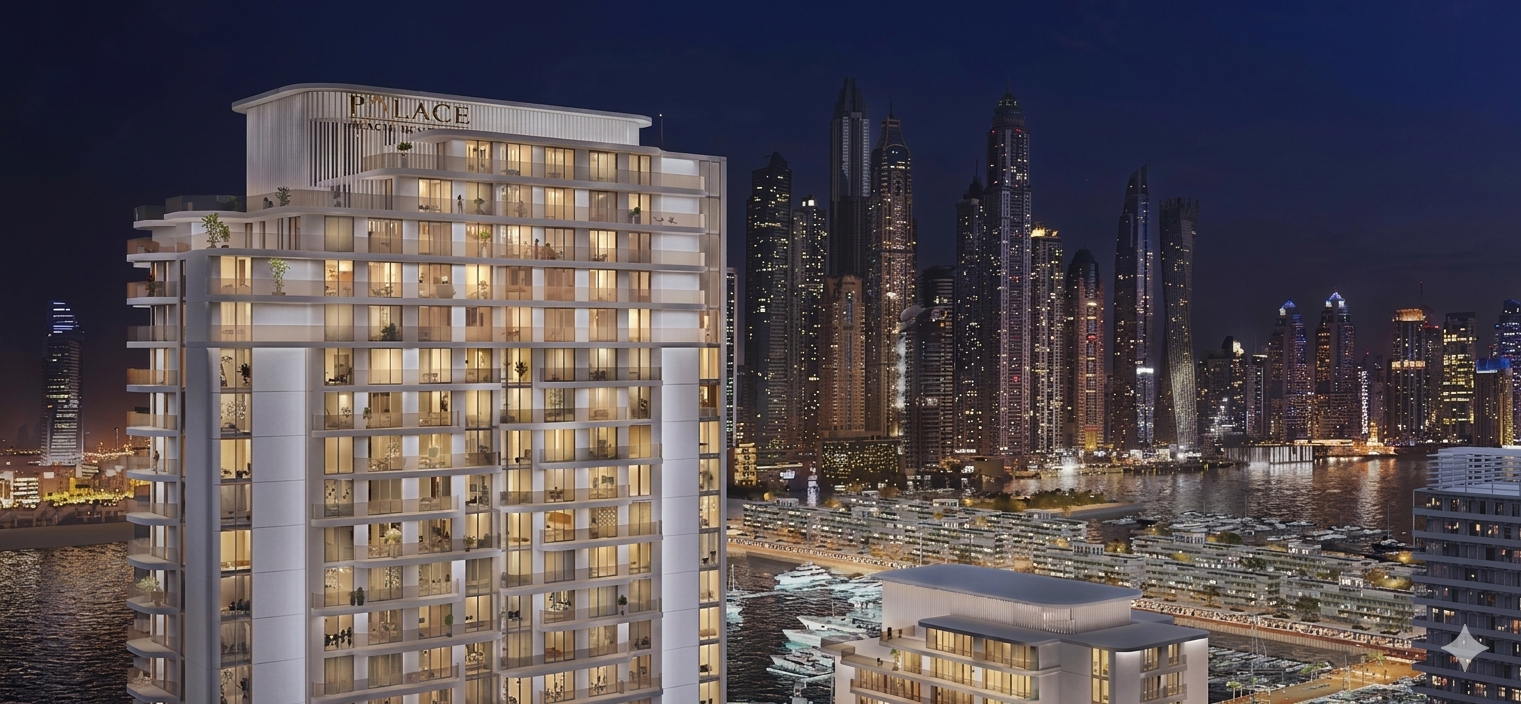
Investors evaluating beachfront assets in Dubai are no longer chasing appreciation alone. The focus has shifted toward sustainable rental income, liquidity during market corrections, and long-term capital resilience. That changes how a project like Emaar Palace by the Beach should be analyzed.
Developed by Emaar Properties, the project enters a market segment where pricing is already elevated, buyer expectations are higher, and competition from branded waterfront communities is increasing. The key question is not whether the development looks premium. The question is whether the numbers justify entry at current valuation levels.
Emaar Palace by the Beach sits within a luxury coastal positioning strategy that targets both investors and affluent end-users. For investors, the opportunity depends heavily on entry price discipline, holding duration, and the strength of short-term versus long-term rental demand.
Where Emaar Palace by the Beach Fits in Dubai’s Current Capital Cycle
Dubai’s premium waterfront market has outperformed mid-market communities over the past three years, primarily because high-net-worth inflows accelerated after global inflation cycles and tax migration trends favored the UAE. However, luxury inventory has also expanded rapidly.
That matters because supply expansion compresses future appreciation potential unless the project carries differentiated demand drivers. Emaar Palace by the Beach benefits from the brand equity of Emaar Properties, which historically improves resale confidence and financing accessibility compared to smaller developers.
The broader Dubai real estate market is now entering a more selective phase. Investors are no longer purchasing purely on launch momentum. Projects must show defensible rental yield, realistic occupancy assumptions, and exit liquidity.
In that environment, beachfront projects maintain an advantage because waterfront land remains structurally limited. Even during slower cycles, coastal inventory in Dubai tends to retain value better than inland speculative launches.
How the Pricing Structure Impacts Real Investor Returns
Emaar Palace by the Beach competes in Dubai’s upper-mid luxury coastal bracket. Comparable waterfront projects in premium districts currently trade between AED 2,400 and AED 3,500 per square foot depending on view corridors, brand affiliation, and handover timeline.
Assuming an average acquisition size of 1,200 sq. ft. at AED 2,900 per sq. ft., the estimated acquisition cost reaches approximately AED 3.48 million before registration fees, broker commissions, furnishing costs, and service charges.
The true investor cost basis matters more than launch pricing headlines. After including Dubai Land Department fees, trustee charges, furnishing allocation, and reserve liquidity, the realistic capital deployment approaches AED 3.75–3.9 million.
This is where many retail investors miscalculate ROI. Gross appreciation projections often ignore operational carrying costs and financing expenses. In luxury beachfront real estate, service charges can materially reduce net yield performance.
The payment plan structure partially offsets this risk. Staggered payments reduce capital lock-in during construction and improve leverage efficiency for investors using partial financing strategies.
What Rental Income Could Actually Look Like
The strongest investment argument for Emaar Palace by the Beach is not aggressive capital appreciation. It is income durability.
Beachfront communities in Dubai consistently attract both long-stay executive tenants and short-term premium tourism demand. Depending on furnishing strategy and property management quality, annual rental income could range between AED 220,000 and AED 320,000.
Under conservative assumptions, long-term leasing may generate gross rental yields near 6%. Short-term holiday rental operations could push gross yields toward 7–8%, although operational volatility and occupancy fluctuations increase.
Net yield is more important. After service charges, maintenance, furnishing depreciation, platform fees, and vacancy assumptions, realistic net ROI may settle between 4.5% and 5.8%.
That range remains competitive relative to many global luxury markets where beachfront residential yields frequently compress below 3%.
The project therefore works better as a medium-term wealth preservation and income vehicle rather than a speculative flip opportunity.
Why Coastal Demand in Dubai Still Supports Premium Assets
Luxury demand in Dubai is increasingly tied to migration patterns rather than tourism alone. High-income residents relocating from Europe, Asia, and parts of the Middle East continue prioritizing waterfront communities due to lifestyle positioning and long-term rental stability.
Projects linked to established master developers generally perform better because buyers perceive lower execution risk. This matters significantly during resale.
Emaar Palace by the Beach also benefits from proximity to hospitality infrastructure, leisure districts, and premium retail ecosystems. In Dubai, integrated communities tend to sustain occupancy rates better than isolated luxury towers.
Another important factor is tenant psychology. Premium tenants often prefer branded or institutionally managed developments because operational consistency matters more at higher rental thresholds.
That directly strengthens rental resilience during economic slowdowns.
A Realistic Investor Model Using Current Market Assumptions
Consider an investor purchasing a unit for AED 3.8 million with a 50% down payment structure and partial financing.
Assuming annual rental income of AED 270,000 and annual operating expenses near AED 70,000, the net operating income would approximate AED 200,000 before financing costs.
If financing costs remain near current UAE mortgage levels, leveraged cash-on-cash returns may land between 6% and 7% annually depending on occupancy stability.
However, appreciation assumptions should remain conservative. Expecting 40–50% capital growth over short holding periods is unrealistic in the current cycle.
A more defensible projection would assume annualized appreciation between 5% and 8% over a five-year horizon if Dubai’s luxury demand remains stable.
Under that framework, total investor return potential becomes attractive but not extraordinary. The project performs best for capital preservation with moderate growth rather than high-risk speculative investing.
How Emaar Palace by the Beach Compares Against Nearby Alternatives
Compared with secondary waterfront developers, Emaar Palace by the Beach carries stronger brand trust and historically better resale absorption.
Against ultra-luxury branded residences, however, pricing efficiency becomes more competitive. Some branded projects command significantly higher premiums without proportionate rental yield improvement.
Relative to inland luxury districts, beachfront positioning provides stronger defensive value during slower market phases. Coastal assets historically experience lower inventory distress because land scarcity limits oversupply risk over the long term.
Still, some competing communities currently offer higher entry yields because their acquisition prices remain lower. Investors prioritizing pure cash flow may find stronger rental percentages outside the beachfront category.
Emaar Palace by the Beach therefore appeals more to balanced investors seeking both income and asset quality rather than maximum yield extraction.
Which Buyer Profile Benefits Most From This Project
The project suits investors with medium-to-long holding periods who prioritize asset durability over aggressive speculative upside.
High-net-worth buyers seeking currency diversification through Dubai real estate may find the project strategically attractive because waterfront inventory retains global appeal.
End-users also benefit from the development because lifestyle demand supports long-term value retention. However, purely yield-focused investors with limited capital may achieve better percentage returns in emerging mid-market communities.
The strongest fit is for investors allocating capital into premium Dubai real estate as part of a broader portfolio strategy rather than chasing short-term trading profits.
The Risks That Cannot Be Ignored
Luxury supply expansion remains the primary risk.
Dubai’s development pipeline continues growing aggressively, and premium launches are increasing across several coastal districts. If supply growth exceeds demand growth, rental pricing power could soften.
Another risk is yield compression. As property prices rise faster than rental growth, ROI percentages gradually decline even when nominal rents increase.
Operational dependency also matters. Short-term rental profitability relies heavily on tourism cycles, platform regulations, and professional property management execution.
Interest rate volatility could further pressure leveraged investors if financing costs remain elevated longer than expected.
Lastly, liquidity risk exists at higher ticket sizes. Luxury units typically require longer resale timelines during slower market periods compared with mid-market apartments.
What Sophisticated Investors Are Likely Watching
Institutional and experienced investors are focusing less on headline launch marketing and more on long-term positioning.
For Emaar Palace by the Beach, the strategic advantage lies in three areas: developer credibility, waterfront scarcity, and durable tenant demand.
The investment thesis becomes stronger if acquired at pre-handover pricing with favorable payment terms. Entry discipline is critical because luxury real estate margins narrow significantly when investors overpay during hype cycles.
From a portfolio perspective, the project functions more effectively as a stability-oriented real estate allocation rather than a high-growth speculative asset.
That distinction is important because investor expectations ultimately determine whether an acquisition feels successful.
Final Assessment: Does the Investment Thesis Hold Up?
Emaar Palace by the Beach presents a credible investment case for buyers seeking premium Dubai waterfront exposure with moderate rental income and long-term asset resilience.
The project is unlikely to deliver extreme short-term appreciation, but it offers stronger defensive characteristics than many speculative off-plan launches currently entering the market.
Its value proposition improves substantially for investors prioritizing capital preservation, stable occupancy potential, and long-duration holding strategies.
For aggressive ROI-focused investors chasing maximum yield percentages, alternative mid-market communities may produce better short-term cash flow metrics.
For investors seeking a blend of prestige positioning, rental consistency, and long-term wealth allocation in Dubai, Emaar Palace by the Beach remains competitively positioned within the current market cycle.
FAQ
- Is Emaar Palace by the Beach suitable for short-term investors?
Short-term flipping potential appears limited due to elevated entry pricing and increasing luxury supply.
The project performs better for investors with a multi-year holding strategy. - What rental yield can investors realistically expect?
Net rental yields may realistically range between 4.5% and 5.8% after expenses.
Short-term leasing strategies could slightly improve returns with higher operational risk. - Does the Emaar brand materially affect resale value?
Projects by Emaar Properties generally attract stronger resale confidence in Dubai.
That often improves liquidity compared with lesser-known developers. - Is the project overpriced compared with nearby developments?
Pricing sits within Dubai’s premium beachfront range rather than extreme luxury territory.
However, investors must negotiate entry carefully to preserve ROI margins. - How important is the payment plan for investors?
Flexible payment structures improve capital efficiency and reduce upfront liquidity pressure.
This becomes especially useful during construction phases. - Would long-term leasing outperform holiday rentals here?
Holiday rentals may produce higher gross income during strong tourism cycles.
Long-term leasing generally provides more stable occupancy and predictable cash flow. - What is the largest risk facing this investment?
Luxury oversupply remains the key concern across Dubai’s premium market.
Future inventory growth could pressure both pricing and rental growth. - Can overseas investors finance purchases in this project?
International buyers can typically access UAE mortgage financing subject to eligibility criteria.
Financing costs will significantly affect overall cash-on-cash returns. - How does this compare with inland luxury communities?
Beachfront properties usually hold stronger long-term scarcity value in Dubai.
Inland communities may offer higher percentage yields but weaker prestige positioning. - Is Emaar Palace by the Beach better for income or appreciation?
The project currently appears stronger as an income-plus-stability investment.
Expectations for aggressive short-term appreciation should remain conservative.