
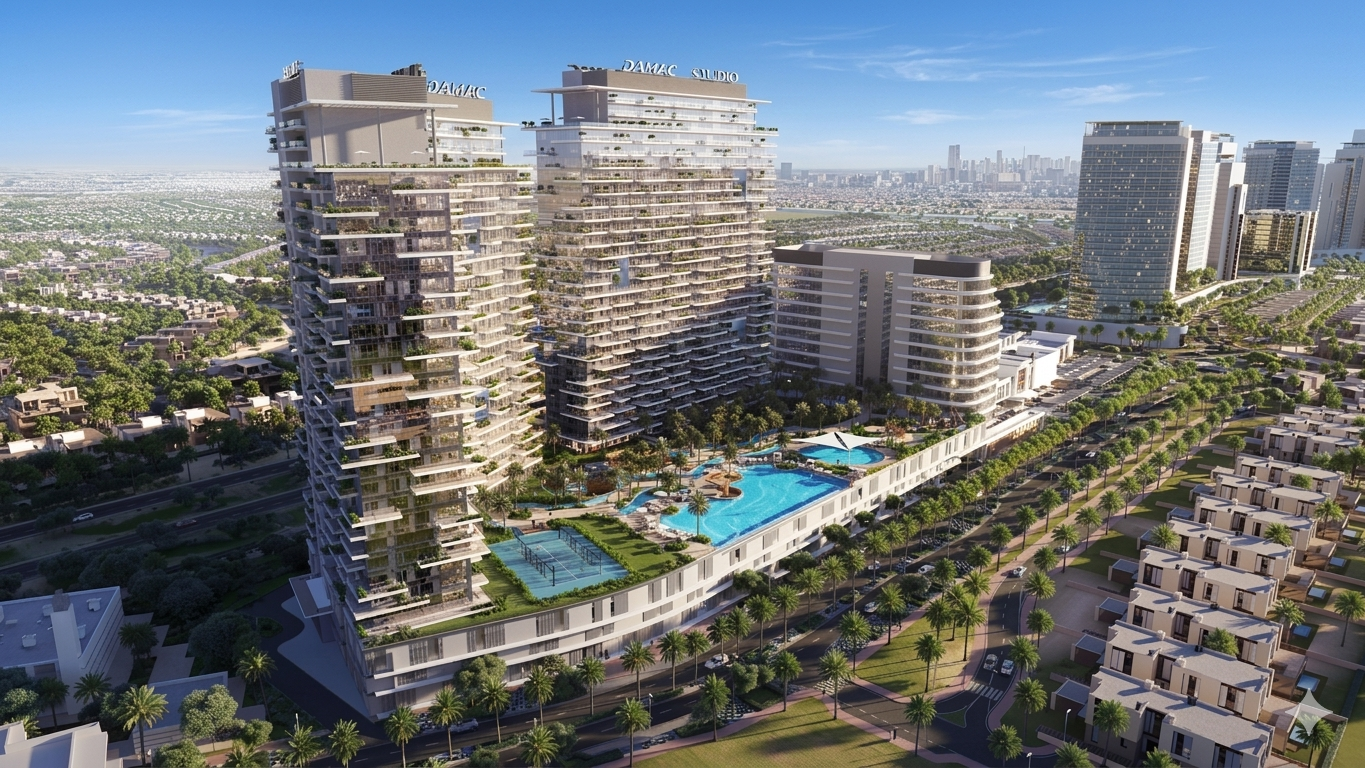
Damac District is being actively evaluated for its price positioning, rental yield potential, and overall real estate ROI Dubai profile. The key investor question is whether this project delivers sustainable rental income Dubai or simply reflects a developer-driven pricing strategy.
This analysis focuses on actual numbers—property price Dubai benchmarks, yield expectations, and comparative positioning—so investors can determine if Damac District is a viable capital allocation opportunity or a marginal performer.
Market Context: Mid-Market Apartments vs Premium Assets
Dubai’s 2026 property cycle continues to favor apartments for rental yield and liquidity, while villas remain appreciation-driven due to limited supply.
Projects by DAMAC Properties typically target the mid-to-upper mid-market segment, where pricing is accessible but supply levels are high. This segment offers stronger rental yield but faces competition-driven pricing pressure.
For investors, this means returns depend more on entry price discipline and tenant demand than scarcity or brand premium.
Damac District Price, Payment Plan & Cost Structure
Damac District price levels in 2026 generally range from AED 750K to AED 1.9M, depending on unit configuration and location within the development. This places it within Dubai’s competitive investor-friendly bracket.
Price per sq. ft. typically falls between AED 1,200 and AED 1,700, aligning with mid-market standards. This indicates that the project is neither deeply discounted nor aggressively overpriced.
Payment plans are usually structured around 60/40 or extended post-handover options, which improve affordability and investor entry flexibility. Service charges are expected between AED 12–16 per sq. ft., which moderately impacts net ROI.
From a valuation standpoint, Damac District appears fairly priced with limited immediate upside from price inefficiency.
Damac District ROI & Rental Yield Analysis
Damac District offers realistic gross rental yields between 6% and 7.2%, depending on unit size and furnishing strategy. This is consistent with Dubai’s mid-market investment segment.
After adjusting for service charges, vacancy, and maintenance, net ROI typically falls between 5% and 6%. This positions it as a stable income-generating asset rather than a high-growth opportunity.
Studios and one-bedroom units tend to outperform larger units due to stronger tenant demand and better yield efficiency.
Location Analysis: Connectivity and Demand Drivers
Damac District is positioned within Dubailand, an area known for affordable housing and steady tenant demand. Connectivity to Downtown Dubai and major highways ensures accessibility to employment hubs.
Compared to Dubai Marina, entry prices are significantly lower, which supports higher yield but reduces global investor appeal and liquidity.
Infrastructure development in Dubailand continues to improve, but it remains less mature than central Dubai locations, which impacts long-term appreciation speed.
Real Investor Scenario: ROI in Practice
Assume a one-bedroom unit purchased at AED 1.1M. At a gross rental yield of 6.8%, annual rental income would be approximately AED 74,800.
After deducting service charges of around AED 13,000 and accounting for vacancy and maintenance, net income reduces to roughly AED 58,000. This results in a net ROI of approximately 5.3%.
Short-term rental strategies may increase gross income slightly, but long-term leasing remains the more stable and predictable approach in this segment.
Competitor Comparison: Price vs Yield vs Liquidity
Compared to Jumeirah Village Circle, Damac District offers similar yield potential but slightly lower liquidity due to JVC’s higher transaction volume and tenant turnover.
Against Business Bay, it provides higher yield at a lower entry price, but lacks the corporate tenant base and appreciation potential.
Relative to other Dubailand projects, pricing is competitive with no significant premium, making it a neutral entry point rather than a discounted opportunity.
Who Should Invest in Damac District
Damac District is suitable for investors seeking stable rental income with moderate capital commitment. It aligns with portfolios targeting 5%–6% net ROI and consistent occupancy rates.
It is not suitable for investors aiming for rapid appreciation or those prioritizing high-liquidity premium locations. It also does not fit ultra-high-yield strategies exceeding 7.5% net returns.
Risks & Limitations
The primary risk is supply saturation within the mid-market apartment segment, which can limit rental growth and price appreciation.
Dependence on broader Dubailand development progress introduces uncertainty in long-term value growth.
Service charges and operational costs reduce net yield, particularly for investors with thin margin expectations.
Resale liquidity may be slower compared to central districts, especially during market downturns.
Strategic Investment Insight
Entry at early launch stages offers marginal pricing advantage, as mid-market projects rarely experience sharp post-handover appreciation.
A holding period of 4–6 years is optimal to maximize rental income and capture gradual market appreciation.
Exit strategy should align with investor demand cycles, particularly when yields remain attractive relative to financing costs.
Final Verdict: Investment Classification
Damac District is a yield-focused investment with stable rental income and limited appreciation upside.
It offers predictable returns within the mid-market segment but lacks the scarcity and premium positioning required for strong capital growth.
FAQs
• What is the price of Damac District in 2026?
Prices range from AED 750K to AED 1.9M depending on unit size. It is positioned in the mid-market segment.
• What rental yield can investors expect?
Gross yields range from 6% to 7.2%. Net ROI typically falls between 5% and 6%.
• Is Damac District a good investment?
Yes, for stable rental income. It is not ideal for high appreciation strategies.
• How does it compare to JVC?
It offers similar yields but slightly lower liquidity. JVC has higher transaction activity.
• Are service charges reasonable?
Yes, typically between AED 12–16 per sq. ft. They moderately impact net ROI.
• Is short-term rental viable here?
Limited compared to tourist areas. Long-term rentals provide more consistent income.
• What is the ideal holding period?
A 4–6 year holding period is recommended. This balances income and appreciation.
• Is the location good for tenants?
Yes, demand is steady due to affordability. It attracts professionals and families.
• What are the main risks?
Supply saturation and slower appreciation are key risks. Market cycles also affect resale.
• Should first-time investors consider this project?
Yes, especially for income-focused strategies. It offers relatively low entry with stable returns.