Buying property on Al Jubail Island in 2026 is a very different proposition from buying a standard Abu Dhabi apartment. The community is being built around low-density residential development, large villas, waterfront homes, mangrove landscapes and a limited number of apartment and townhouse options. That scarcity is one reason prices have moved sharply, but it also means investors need to distinguish between a property bought for rental income and one bought primarily for long-term capital appreciation.
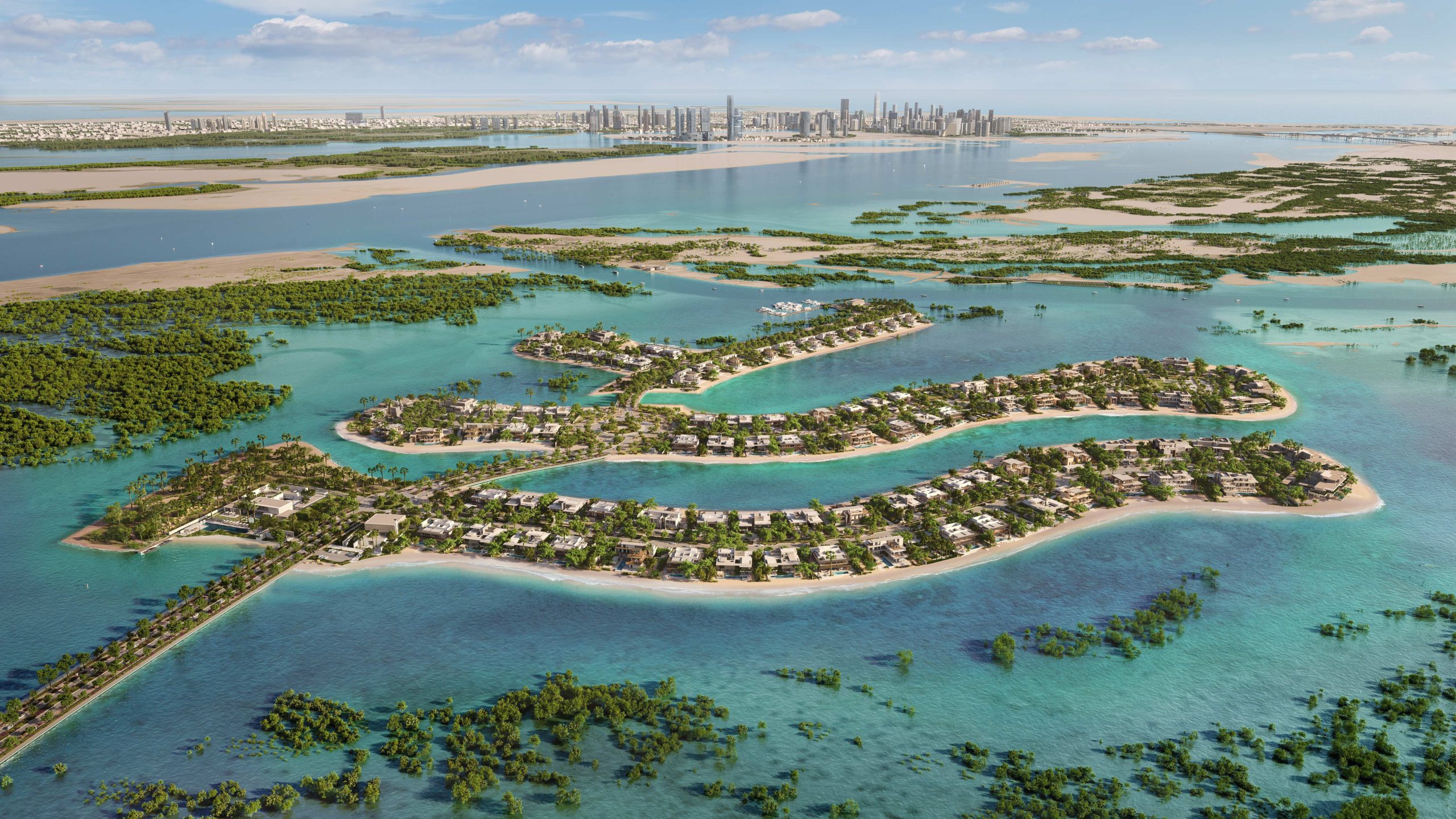
For UAE residents considering an Abu Dhabi property purchase, Al Jubail Island sits in an unusually strategic position between Saadiyat Island and Yas Island. The community is designed around six villages and covers approximately 40 million sq. m, with only around 20% planned as developed land according to the official Jubail Island FAQ. More than 1,000 homes had already been completed and handed over by April 2026.
The investment question, however, is more specific: Is Al Jubail Island worth buying in 2026, what does property cost, which village should you choose, and can the rental income justify the entry price? This guide analyses those questions using current asking prices, rental listings, market growth data and realistic investor scenarios.
Al Jubail Island Property Investment: 2026 Market Snapshot
Al Jubail Island has moved into a more mature phase of its development. It is no longer purely a future master-planned project: residents are already occupying properties, rental listings are active, Jubail Terraces has apartments available, and multiple villa communities have completed or near-completed homes.
Knight Frank’s latest Abu Dhabi residential market review provides one of the strongest current signals: villas on Al Jubail Island recorded approximately 40% annual price growth to June 2026, making it one of the fastest-growing villa markets in the emirate during that period.
That performance is significant, but investors should not assume a further 40% increase is the base case.
Rapid price appreciation changes the investment calculation because rental yields can become compressed when property values rise faster than rents.
Current asking inventory demonstrates the premium already attached to the island. Bayut listings include a 4-bedroom villa around AED 9.5 million, a 4-bedroom villa at approximately AED 11.5 million, 5-bedroom villas around AED 16–18.5 million, and larger waterfront residences reaching AED 24–30 million.
At the apartment level, Property Finder currently shows Jubail Terraces units around AED 2.5–2.8 million for 1-bedroom apartments, depending on size and specifications.
This makes Al Jubail Island a market where the buyer’s objective matters enormously.
Rental investor: focus on entry price and achievable rent.
End user: focus on layout, village and daily convenience.
Long-term investor: focus on land scarcity, village positioning and resale demand.
What Makes Al Jubail Island Different in Abu Dhabi?
The island’s investment proposition is built around low-density development rather than maximum construction volume.
The official masterplan describes six villages:
- Marfaa Al Jubail
- Nad Al Dhabi
- Seef Al Jubail
- Souk Al Jubail
- Ain Al Maha
- Bada Al Jubail
The official FAQ states that only around 20% of the island is developed and that the planned residential mix includes 854 villas, 164 plots, 303 townhouses and 465 apartments, with more than 10,000 residents ultimately expected.
This matters for property investors because land availability and density influence the competitive supply of comparable homes.
A buyer purchasing a villa in a low-density waterfront village is not competing against thousands of identical towers.
However, scarcity alone does not guarantee appreciation. The property still needs a buyer or tenant willing to pay the premium.
That is where Al Jubail Island’s location becomes important.
Al Jubail Island Location: Why the Position Matters to Investors
Al Jubail Island is positioned between Yas Island and Saadiyat Island, placing it within Abu Dhabi’s expanding island-based residential and leisure corridor. Property Finder describes the island as being between the two destinations, while the official development information highlights access through Sheikh Khalifa Bin Zayed Highway (E12), using the dedicated Jubail Island bridge.
The location creates several potential demand sources.
Yas Island employment and leisure demand
Yas Island provides employment, entertainment, hospitality and tourism activity. Residents who want access to Yas but prefer a quieter residential setting can consider Jubail.
Saadiyat Island proximity
Saadiyat provides access to cultural destinations, beaches and premium residential areas. Jubail therefore sits close to another high-value residential market without having the same urban density.
Abu Dhabi city access
The island is close enough to Abu Dhabi’s central districts for residents who want a quieter home without completely disconnecting from the city.
Airport access
Jubail Island is also positioned within Abu Dhabi’s wider airport and eastern development corridor.
For investors, this gives the community several potential tenant profiles rather than relying on one employment district.
Al Jubail Island Property Prices in 2026
Unlike Al Reem Island or Al Raha Beach, where apartment inventory dominates, Al Jubail Island is strongly weighted toward villas and townhouses.
Current asking prices provide a useful framework:
| Property type | Indicative 2026 asking range |
|---|---|
| 1BR apartment | AED 2.5M–2.8M+ |
| 2BR apartment | AED 3M+ depending on project/size |
| 3BR townhouse | AED 5.5M–6.5M+ |
| 4BR villa | AED 9M–12M+ |
| 5BR villa | AED 15M–20M+ |
| Large waterfront villa | AED 20M–30M+ |
| Mansion/large bespoke property | AED 20M+ |
These are indicative asking levels, not confirmed transaction prices. Current listings illustrate the spread: Bayut shows a 3-bedroom townhouse at approximately AED 5.9 million, while 4-bedroom villas are listed around AED 9.5–11.5 million and larger 5-bedroom properties range into the AED 18–24 million bracket.
The spread is primarily explained by:
- Village
- Plot size
- Built-up area
- Waterfront position
- Villa typology
- Garden
- Single-row location
- View
- Completion status
- Interior upgrades
Therefore, quoting a single “average Al Jubail Island property price” can be misleading.
Al Jubail Island Villas: What Are Buyers Actually Paying For?
The official villa portfolio includes 4-bedroom, 5-bedroom and 6-bedroom configurations, with different typologies including V4, V4 Select, V4 Executive, V5, V5 Select, V5 Executive, V6 Select and V6 Elite. Official specifications show 4-bedroom villas with approximately 423 sq. m of GSA, while selected 6-bedroom configurations are around 813–831 sq. m.
That means two properties described simply as “4-bedroom villas” can have very different investment values.
For example:
Villa A
- AED 9.5M
- 4 bedrooms
- 10,553 sq. ft. listing area
- Ready
- Standard location
Villa B
- AED 11.5M
- 4 bedrooms
- 7,820 sq. ft.
- Souk Al Jubail
- Premium positioning
Both can be marketed as 4-bedroom villas, but the investment calculation is not interchangeable.
The buyer should therefore compare price per sq. ft., plot size, rental value and village-specific demand, not bedroom count alone.
Al Jubail Island Rental Market: What Can Owners Earn?
The rental market is already active.
Property Finder currently shows 187 rental properties on Al Jubail Island, comprising approximately 80 villas, 58 townhouses, 47 apartments and two duplexes. The current rental inventory ranges from approximately AED 90,000 to AED 1.2 million annually.
Property Finder’s area-level data currently indicates approximate average apartment rents of:
| Apartment type | Average annual rent |
| Studio | AED 116,000 |
| 1-bedroom | AED 168,000 |
| 2-bedroom | AED 245,000 |
The current listings provide a more granular picture.
For example, Jubail Terraces 1-bedroom apartments are currently advertised around AED 150,000–200,000 annually, with sizes ranging from roughly 1,084 to 1,774 sq. ft. in the examples available. Two-bedroom apartments are being advertised around AED 200,000–260,000 depending on size and specification.
This creates a potentially interesting apartment investment case.
Al Jubail Island ROI: Can Rental Income Justify the Price?
Consider a 1-bedroom Jubail Terraces apartment purchased for AED 2.5 million.
Assume achievable annual rent of AED 168,000, in line with Property Finder’s current area-level apartment data.
Gross rental yield
AED 168,000 ÷ AED 2,500,000 × 100
= 6.72% gross yield
Now allow for ownership costs.
A reasonable preliminary underwriting assumption could include:
- Service charges: AED 20,000
- Maintenance reserve: AED 5,000
- Leasing/management/miscellaneous: AED 8,000
Estimated annual costs:
AED 33,000
Estimated net rental income:
AED 168,000 − AED 33,000 = AED 135,000
Estimated net yield:
AED 135,000 ÷ AED 2.5M × 100 = 5.4%
This is an illustrative investor calculation, not a guaranteed return. Actual service charges, rent, vacancy, management fees and maintenance must be confirmed for the exact unit.
The important observation is that the apartment segment can potentially produce a more attractive percentage yield than some of the island’s larger villas.
Al Jubail Island Villa ROI: A Different Investment Equation
Now consider a 4-bedroom villa purchased for AED 9.5 million.
Current rental listings show 4-bedroom villas reaching around AED 600,000 annually in some cases, although rental values vary by village, plot, specification and waterfront position. Property Finder currently has a 4-bedroom Seef Al Jubail villa advertised at AED 600,000 per year.
Using AED 600,000 as the hypothetical annual rent:
AED 600,000 ÷ AED 9.5M × 100 = 6.32% gross yield
Now assume:
- Service/maintenance costs: AED 55,000
- Landscaping/pool/maintenance reserve: AED 25,000
- Management/leasing/miscellaneous: AED 20,000
Estimated annual costs:
AED 100,000
Estimated net income:
AED 500,000
Estimated net yield:
AED 500,000 ÷ AED 9.5M × 100 = 5.26%
Again, this is a scenario, not a promise.
It demonstrates why villas can still work financially even at high acquisition prices when the rental market supports them.
However, the investor also needs to consider the much larger capital requirement and potentially narrower resale market.
Which Al Jubail Island Village Should You Buy?
This is one of the most important questions for a buyer.
Al Jubail Island is not one homogeneous neighbourhood. Each village has a different investment profile.
Marfaa Al Jubail
Marfaa Al Jubail is the marina-oriented village.
The official masterplan positions it around a marina, yacht club, waterfront residences, restaurants and a promenade.
For investors, this can be attractive for buyers seeking:
- Waterfront townhouses
- Marina-oriented residences
- Premium rental positioning
- Smaller residential formats
- End users who value boating access
The key risk is the premium attached to the marina location.
If a waterfront property costs significantly more but generates only a modest rental premium, the investor should calculate whether the capital appreciation thesis justifies the difference.
Nad Al Dhabi
Nad Al Dhabi is positioned as a family-oriented residential area with parks, sports facilities and community amenities.
This can make it more suitable for family-focused investors.
The potential advantage is a broader end-user market for buyers looking for larger villas without necessarily requiring direct beachfront positioning.
Seef Al Jubail
Seef Al Jubail focuses on larger shoreline villas and access to the beach and beach club.
This is a particularly interesting segment for high-income family tenants.
Current rental listings show a 4-bedroom Seef Al Jubail villa at approximately AED 600,000 annually, while another current 3-bedroom townhouse on the island is listed at AED 300,000.
That rental gap illustrates how much property type and size can influence income.
Souk Al Jubail
Souk Al Jubail is arguably the most interesting village for buyers who prioritise convenience.
The official development describes it as a walkable hub with plazas, retail, restaurants, green spaces and everyday services. Spinneys is already open, and the development has highlighted further education and community facilities.
Jubail Terraces is located here, providing the island’s apartment-focused investment opportunity.
For a UAE resident with a smaller budget, Souk Al Jubail may therefore be the logical entry point into Al Jubail Island.
Ain Al Maha
Ain Al Maha is surrounded by mangroves and water channels and offers larger villas.
Current Bayut inventory includes 4-bedroom villas around AED 9.5 million and 5-bedroom villas from roughly AED 15.5 million upward, with some significantly larger properties listed above AED 20 million.
This is more suitable for high-net-worth buyers than conventional yield-focused investors.
Bada Al Jubail
Bada Al Jubail is the ultra-high-end segment, with large mansion plots and bespoke residences.
The official FAQ says plots in Bada Al Jubail range from 2,000 to 6,000 sq. m, with nine mansion typologies ranging from approximately 1,100 to 3,000 sq. m GSA.
This is not the segment to enter if the main objective is maximum rental yield.
It is more appropriate for buyers seeking a highly customised residence and long-term capital preservation.
Al Jubail Island vs Saadiyat Island
Saadiyat Island is the obvious benchmark for a premium Abu Dhabi buyer.
Knight Frank reported Saadiyat Island as Abu Dhabi’s most expensive residential location, with apartment values around AED 43,100 per sq. m as of June 2026.
The comparison is useful because both markets attract affluent residents, but the investment thesis differs.
| Factor | Al Jubail Island | Saadiyat Island |
| Main product | Villas, townhouses, apartments | Apartments, villas, branded residences |
| Development character | Low-density, nature-led | Cultural/beach premium |
| Villa price growth | ~40% YoY to June 2026 | Premium market |
| Rental strategy | Family villas + selected apartments | Broad luxury rental market |
| Main advantage | Scarcity + low density | Established premium address |
| Main risk | High villa entry price | High acquisition premium |
Al Jubail’s 2026 villa growth is particularly notable, but Saadiyat has the advantage of a more established premium market.
For an investor seeking a newer scarcity-driven market, Jubail can be more interesting.
For an investor prioritising established luxury demand and proven resale depth, Saadiyat may be easier to underwrite.
Al Jubail Island vs Yas Island
Yas Island is another important alternative.
Yas has a broader mix of apartments, townhouses and villas, along with a much larger entertainment and hospitality ecosystem.
Al Jubail offers a lower-density residential proposition.
For investors:
Choose Yas Island if your priority is a broad tenant market and greater diversity of apartment and villa stock.
Consider Al Jubail Island if your thesis depends on low-density development, waterfront scarcity and affluent family demand.
The price comparison should always be done on the individual property rather than the island average.
Is Al Jubail Island Good for Off-Plan Investment?
Off-plan opportunities can be attractive, but Al Jubail requires a different analysis from a high-volume apartment district.
The key question is whether the off-plan price provides sufficient upside over existing completed properties.
Suppose:
Ready villa: AED 10M
Off-plan villa: AED 10.5M
If the off-plan property offers a flexible payment plan but only modest specification advantages, the premium may not be justified.
But if the off-plan property offers:
- Better waterfront positioning
- Larger plot
- Newer design
- Stronger village location
- Attractive payment schedule
then the additional price may be defensible.
The buyer should compare the future handover value with today’s completed resale prices.
Al Jubail Island Payment Plan: What Buyers Should Check
Payment plans can make the high acquisition price more manageable.
However, a low initial payment does not reduce the total purchase price.
Before committing to an off-plan property, calculate:
- Booking payment
- Construction instalments
- Handover amount
- Registration costs
- Mortgage requirement
- Post-handover obligations
- Service charges
- Expected rental start date
For example, a AED 10 million property with a 10% initial payment requires AED 1 million upfront, but the buyer still needs to plan for AED 9 million in future obligations.
This is particularly important for UAE residents using salary income rather than existing investment capital.
Who Should Invest in Al Jubail Island?
High-net-worth UAE residents
The villa and mansion segments are naturally suited to buyers with substantial capital who want both personal use and long-term asset exposure.
Family investors
Nad Al Dhabi, Seef Al Jubail and selected Ain Al Maha properties can appeal to tenants seeking larger homes and access to community facilities.
Rental investors with AED 2.5M–4M
Jubail Terraces provides a more accessible route into the island than buying a multi-million-dirham villa. Current 1-bedroom listings around AED 2.5–2.8 million create a lower entry point than much of the island’s villa stock.
Long-term investors
The island’s low-density masterplan and limited residential inventory can support a long-term scarcity thesis.
Who Should Not Buy Al Jubail Island?
Al Jubail Island may not be suitable if:
- You need a low-cost entry into Abu Dhabi.
- You require a very high immediate rental yield.
- You plan to flip within a few months.
- You are uncomfortable with a premium residential market.
- You need a highly liquid apartment market with hundreds of comparable units.
- You are buying a large villa purely because it looks impressive without calculating its rental yield.
The island is better suited to a five-year-plus investment horizon than a short-term trading strategy.
Key Risks of Investing in Al Jubail Island
1. High acquisition prices
Villa prices have risen rapidly. Knight Frank’s approximately 40% annual growth figure to June 2026 is evidence of this momentum, but it also means buyers entering today should avoid assuming the same growth rate will continue.
2. Yield compression
If property prices rise faster than rents, rental yields can decline.
3. Limited comparable sales
Some large villas have very few directly comparable properties, making valuation more difficult.
4. New supply
As additional homes are delivered, tenants will have more options within the island.
5. Service and maintenance costs
Large villas can carry significant landscaping, pool, maintenance and community costs.
6. Resale liquidity
A AED 20 million villa has a much smaller potential buyer pool than a AED 2.5 million apartment.
7. Waterfront premiums
The highest-priced waterfront property is not automatically the highest-return investment.
The Best Al Jubail Island Investment Strategy for 2026
The right strategy depends on your budget.
If your budget is AED 2.5M–4M
Focus on Jubail Terraces apartments.
Compare:
- Purchase price
- Rent
- Service charges
- Floor area
- View
- Parking
- Rental demand
- Resale supply
A 1-bedroom apartment around AED 2.5 million with approximately AED 168,000 annual rent could produce a gross yield above 6%, before expenses, based on current area-level rental data.
If your budget is AED 5M–8M
Consider townhouses.
Current listings include a 3-bedroom townhouse around AED 5.9 million, while rental examples around AED 275,000–300,000 demonstrate the potential income range.
If your budget is AED 9M–15M
This is where 4-bedroom villas become accessible.
The key decision is village.
Compare Nad Al Dhabi, Seef Al Jubail, Souk Al Jubail and Ain Al Maha according to plot size, water access, rental value and resale demand.
If your budget exceeds AED 15M
Do not evaluate the property purely by rental yield.
At this level, the decision increasingly becomes about:
- Land scarcity
- Waterfront position
- Plot size
- Privacy
- Bespoke design
- Capital preservation
- Long-term resale
When Is the Right Time to Buy Al Jubail Island Property?
The market has already delivered significant price growth.
That does not mean buyers should automatically wait for a correction, nor does it mean they should rush to buy.
Instead, look for relative value within the island.
A villa priced 10% below comparable completed homes can be more interesting than a new villa launching at the top of the market.
Likewise, an apartment producing a 6%+ gross yield can potentially be more attractive than a villa producing 4–5%, depending on the investor’s objective.
The ideal entry point is therefore not necessarily the lowest market price.
It is the point where:
purchase price + ownership costs are justified by rent + scarcity + expected resale demand.
Is Al Jubail Island Worth Buying in 2026?
Yes, but it is primarily a selective, long-term investment rather than a mass-market yield play.
The strongest evidence supporting the market is current price momentum. Knight Frank reports approximately 40% annual villa price growth to June 2026, while current listings show strong demand across villas, townhouses and Jubail Terraces apartments.
The strongest structural argument is scarcity. The official masterplan states that only around 20% of the 40 million sq. m island is developed, with a deliberately low-density residential structure.
The strongest rental argument comes from the active market. Property Finder currently shows 187 rental properties across villas, townhouses and apartments, with apartment rents ranging from approximately AED 116,000 for studios to AED 245,000 for 2-bedroom units at area level.
But the biggest warning is valuation.
After approximately 40% villa price growth, buyers should not underwrite another 40% as their base case.
For a rental investor, Jubail Terraces may provide the clearest entry point.
For a family buyer, Seef Al Jubail, Nad Al Dhabi and Ain Al Maha deserve closer consideration.
For a high-net-worth buyer, Bada Al Jubail and large waterfront villas are more about long-term asset positioning than maximum rental yield.
Final Verdict: Should UAE Residents Buy on Al Jubail Island?
For UAE residents, Al Jubail Island is one of Abu Dhabi’s more differentiated property markets in 2026, but its investment case needs to be approached differently from Al Raha Beach, Al Reem Island or Yas Island.
The opportunity is not simply that it is an island.
The stronger investment thesis is the combination of limited development density, waterfront positioning, large residential plots, six distinct villages and an increasingly established community.
The numbers also require discipline. Villa prices have grown rapidly, while current asking prices can reach AED 20–30 million for some of the largest homes.
For an investor seeking rental income, a smaller apartment or townhouse may offer better capital efficiency than a large villa.
For a family seeking a long-term residence, the larger villas in Seef Al Jubail, Ain Al Maha or Nad Al Dhabi may justify the higher price because personal utility becomes part of the decision.
For a high-net-worth buyer, the attraction is different again: land scarcity, waterfront positioning and long-term ownership.
The smartest way to buy Al Jubail Island property in 2026 is to choose the village first, identify the property type second, and negotiate the price only after calculating achievable rent, ownership costs and realistic resale demand.
FAQs About Al Jubail Island
What is the price of property on Al Jubail Island in 2026?
Current asking prices vary significantly. Jubail Terraces 1-bedroom apartments are currently around AED 2.5–2.8 million, while villas range from approximately AED 9.5 million for some 4-bedroom properties to AED 20 million-plus for larger waterfront homes.
Is Al Jubail Island a good investment?
It can be, particularly for investors with a five-year-plus horizon who want exposure to a low-density waterfront community. Knight Frank reported approximately 40% annual villa price growth to June 2026.
What is the ROI on Al Jubail Island property?
ROI depends heavily on property type. A 1-bedroom apartment purchased around AED 2.5 million and rented near AED 168,000 could produce an illustrative gross yield of about 6.72%. Large villas may produce different yields depending on purchase price and achievable rent.
Which area is best in Al Jubail Island?
There is no single best village. Souk Al Jubail can be attractive for apartment buyers because of Jubail Terraces and its retail/community hub. Seef Al Jubail suits buyers seeking larger shoreline villas, while Nad Al Dhabi is more family-oriented and Bada Al Jubail targets mansion-scale properties.
Is Al Jubail Island better than Saadiyat Island?
It depends on the objective. Saadiyat is more established as Abu Dhabi’s premium cultural and residential market, while Al Jubail offers a lower-density, nature-oriented development with substantial villa exposure. Knight Frank identifies Saadiyat as Abu Dhabi’s most expensive residential location, while Al Jubail recorded very strong villa price growth in 2026.
Can I buy an apartment on Al Jubail Island?
Yes. Jubail Terraces provides apartment options, and the official masterplan includes studios through 3-bedroom apartments and duplexes. Current Property Finder listings show 1-bedroom apartments around AED 2.5–2.8 million.
Is Al Jubail Island suitable for rental investment?
Yes, particularly where the purchase price is aligned with achievable rent. Property Finder currently shows active rental listings across apartments, townhouses and villas, including 1-bedroom apartments around AED 150,000–200,000 and 2-bedroom apartments around AED 200,000–260,000 in current listings.