
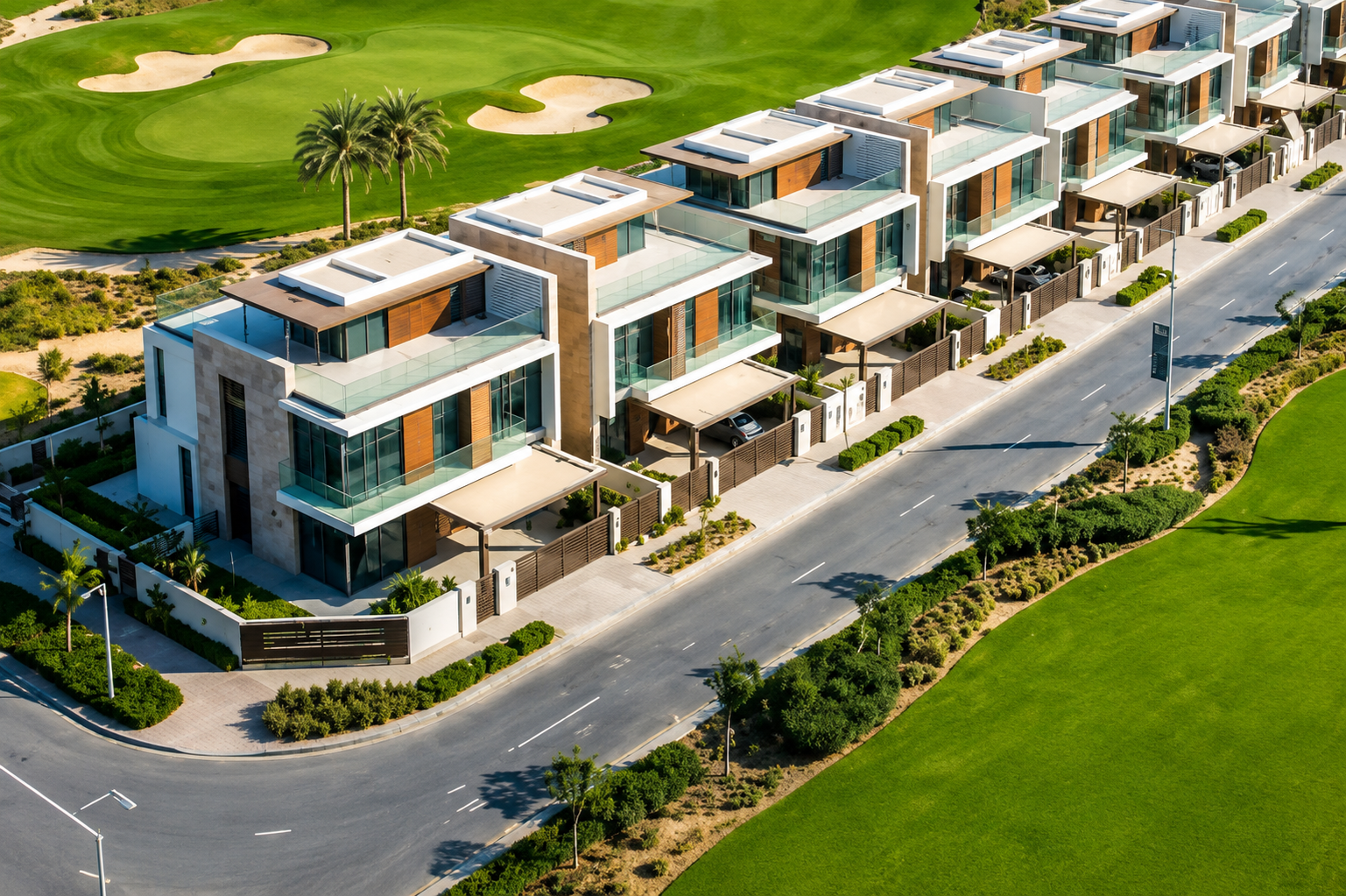
The launch of hudayriyat golf estates places ultra-premium villa inventory into a market segment that has been supply-constrained for years. Unlike mass-market developments competing on discounts and payment plans, this project targets capital preservation, long-term land appreciation, and luxury lifestyle demand tied to waterfront and golf-oriented living.
For investors, the key question is not whether the development looks attractive on paper. The real issue is whether pricing aligns with future absorption, rental depth, and resale demand within Abu Dhabi’s evolving luxury residential market. That is where hudayriyat golf estates becomes a more complex but potentially higher-quality investment case.
Why the Abu Dhabi luxury cycle currently favors hudayriyat golf estates
Modon has strategically entered a phase of the Abu Dhabi property market where premium inventory remains materially lower than demand from high-net-worth residents, GCC buyers, and international investors relocating capital from more volatile markets.
Abu Dhabi recorded sustained luxury transaction growth over the past two years, largely driven by infrastructure spending, residency reforms, and a widening economic diversification strategy. Unlike speculative oversupply cycles historically seen in some Dubai districts, Abu Dhabi’s high-end villa market remains relatively controlled.
Hudayriyat Island itself is being positioned as a destination ecosystem rather than a standalone residential cluster. That distinction matters because destination-led communities typically hold pricing power longer during slower market phases. Investors are effectively buying into land scarcity plus lifestyle infrastructure simultaneously.
From a capital allocation perspective, this creates stronger downside protection compared to generic villa communities with interchangeable supply.
Where hudayriyat golf estates sits on the premium pricing curve
Hudayriyat Island is expected to command pricing materially above standard suburban villa districts because the product combines golf frontage, waterfront access, and limited luxury inventory.
Estimated entry pricing for premium villas in hudayriyat golf estates is likely to begin in the upper luxury bracket relative to broader Abu Dhabi villa inventory. Investors should expect pricing premiums of 20–35% above conventional family villa communities without comparable lifestyle positioning.
That premium only makes sense if three conditions hold over time. First, land release remains controlled. Second, high-income expatriate migration into Abu Dhabi continues. Third, infrastructure execution matches branding expectations.
The total acquisition cost extends well beyond base property price Dubai comparisons. Investors must account for registration fees, service charges, fit-out upgrades, furnishing standards, and financing costs where applicable. In luxury golf communities, operational carrying costs often become the hidden variable reducing net ROI.
A villa purchased at AED 9 million with annual ownership costs approaching AED 140,000–180,000 requires strong rental depth or meaningful appreciation to justify the capital lock-in.
How the rental mathematics actually work at hudayriyat golf estates
Luxury villa investments rarely outperform on raw rental yield alone. The stronger thesis is total return through a combination of moderate income and land appreciation.
Gross rental yield projections for hudayriyat golf estates are realistically expected within the 4.5% to 6% range depending on villa size, golf frontage, furnishing quality, and market timing. Net yields after service charges and maintenance could compress closer to 3.8%–5%.
For investors focused purely on cash flow, there are better-performing mid-market assets elsewhere in the UAE. However, investors prioritizing wealth preservation and long-duration appreciation may view lower yield tolerance as acceptable.
An investor acquiring a luxury villa at AED 10 million and leasing it for AED 520,000 annually would generate approximately 5.2% gross rental income Dubai standards before expenses. After operational costs, realistic net performance could fall below 4.5%.
The investment case therefore depends heavily on appreciation assumptions. If annual capital growth averages 6–8% over a seven-year horizon, total annualized return becomes significantly more compelling.
The demand engines supporting hudayriyat golf estates
The strongest demand driver is not tourism. It is executive-level residential migration.
Abu Dhabi has increasingly attracted senior professionals from finance, energy, technology, and sovereign wealth sectors seeking larger primary residences with lifestyle infrastructure. Golf communities tend to perform best when demand comes from long-term occupants rather than speculative investors.
Hudayriyat Island also benefits from strategic infrastructure expansion including sports facilities, beach destinations, cycling corridors, hospitality assets, and wellness-oriented development planning. These are not cosmetic additions. They increase long-term livability and improve resale defensibility.
Accessibility also matters. Connectivity between central Abu Dhabi districts and Hudayriyat continues improving, reducing one of the traditional barriers associated with island-style master communities.
From an investor standpoint, tenant quality matters as much as tenant quantity. Luxury communities with financially stable tenant profiles usually experience lower vacancy volatility during market corrections.
A realistic investor case study using current assumptions
Assume an investor purchases a golf-facing villa for AED 9.5 million using a 50% down payment structure.
Initial acquisition and setup costs may push total capital deployment above AED 10.2 million. Annual rental income could stabilize near AED 500,000 depending on market maturity and interior specifications.
After service charges, maintenance reserves, and vacancy assumptions, annual net operating income may settle around AED 390,000–420,000.
That translates into a net operational return below many mid-market Dubai assets. However, if the underlying land value appreciates 35–45% over seven years due to limited competing inventory, the overall investment profile changes materially.
This is effectively a hybrid investment between lifestyle real estate and long-duration capital appreciation rather than a pure income asset.
How hudayriyat golf estates compares against competing luxury communities
Compared with premium communities in Dubai, hudayriyat golf estates may initially appear expensive on a yield-adjusted basis. However, Dubai’s luxury market faces broader inventory expansion across multiple districts.
Abu Dhabi’s luxury villa supply pipeline remains narrower, which improves long-term scarcity economics.
Compared with Saadiyat Island luxury villas, hudayriyat golf estates offers stronger sports and golf positioning but may initially lag in global luxury branding recognition. Saadiyat still benefits from museum-driven international visibility and mature waterfront prestige.
Against Yas Island family-oriented communities, Hudayriyat clearly targets a more affluent demographic with stronger exclusivity positioning and larger capital commitments.
For institutional-style investors, the most important variable is future supply competition. At present, Hudayriyat appears structurally better protected from oversupply than many emerging UAE master-planned districts.
Which investor profile is best suited for hudayriyat golf estates
This project fits investors prioritizing long-term asset quality over short-term rental optimization.
Family offices, high-net-worth individuals, and GCC investors seeking portfolio diversification into premium UAE residential real estate are the strongest target profiles. End-users with long holding periods may also benefit from future appreciation cycles.
Investors seeking rapid flipping opportunities may find the liquidity profile less attractive during early community stabilization phases.
Cash-flow-focused investors targeting maximum rental yield should likely allocate capital toward smaller-format apartments or mid-market villa communities where entry prices remain lower and tenant pools broader.
The overlooked risks investors should not ignore
The primary risk is valuation compression if luxury supply expands faster than expected across Abu Dhabi over the next five years.
A second risk involves execution timing. Destination communities depend heavily on infrastructure completion, retail activation, and lifestyle ecosystem delivery. Delays can suppress resale momentum even when the core product quality remains strong.
Luxury real estate also carries thinner buyer pools during economic slowdowns. Liquidity risk becomes more significant above AED 8–10 million price brackets.
Another consideration is opportunity cost. Capital allocated into one premium villa could alternatively be diversified across several mid-market income-generating assets producing stronger immediate ROI Dubai performance.
Investors should therefore treat hudayriyat golf estates as a strategic allocation rather than a yield-maximization trade.
Why timing matters more than headline pricing here
The strongest returns in destination luxury communities are usually generated during the early identity formation phase before full ecosystem maturity.
Once infrastructure, schools, hospitality, retail, and community culture fully stabilize, pricing premiums typically become entrenched. Early investors absorb higher uncertainty but may capture disproportionate upside.
That said, entry discipline remains essential. Investors should negotiate aggressively around launch phases, payment plan flexibility, and premium positioning assumptions. Overpaying in luxury markets materially reduces future return potential.
The optimal strategy is likely medium-to-long-term holding rather than speculative short-term resale.
Final assessment on hudayriyat golf estates as an investment
Hudayriyat golf estates is not positioned as a high-yield asset. It is positioned as a scarcity-driven luxury real estate play tied to Abu Dhabi’s long-term wealth migration and lifestyle expansion strategy.
The investment case works best for buyers seeking capital preservation, moderate rental income, and strong probability of long-term land appreciation within a controlled luxury supply environment.
Investors looking for aggressive rental yield or short-cycle liquidity may find stronger opportunities elsewhere. However, investors focused on premium asset quality and future scarcity economics may view hudayriyat golf estates as one of the more defensible luxury villa plays currently emerging in Abu Dhabi.
FAQs
- Is hudayriyat golf estates better for rental income or appreciation?
The project is more compelling as a long-term appreciation asset than a high-yield rental investment. Net rental returns are likely moderate relative to entry pricing. - What type of buyer will likely drive future demand here?
Senior executives, GCC families, and high-net-worth investors are expected to form the primary buyer base. That supports premium positioning but narrows liquidity depth. - Could the project become overpriced versus market fundamentals?
Yes, particularly if luxury supply accelerates across Abu Dhabi faster than demand growth. Investors should monitor launch pricing carefully. - How does the project compare with Saadiyat Island investments?
Saadiyat carries stronger global branding, while Hudayriyat emphasizes sports, golf, and integrated lifestyle infrastructure. Risk-return profiles differ accordingly. - Are payment plans important for ROI calculations?
Absolutely. Extended payment plans improve leverage efficiency and reduce initial capital strain, materially affecting real estate ROI Dubai outcomes. - Will service charges significantly affect returns?
Luxury golf communities typically carry higher operational costs. These expenses can materially reduce net rental yield if underestimated. - Is there enough tenant demand for ultra-luxury villas in Abu Dhabi?
Demand exists but remains relatively niche compared to mid-market housing. Tenant quality is strong, though leasing periods may be longer. - What is the biggest investment risk in this project?
Execution timing and luxury market liquidity are the primary risks. Delays in ecosystem development can temporarily weaken resale momentum. - Can overseas investors realistically benefit from this market?
Yes, particularly those seeking UAE exposure with lower perceived volatility than speculative urban high-rise segments. Long holding periods remain important. - Does hudayriyat golf estates suit short-term investors?
Not ideally. The project appears structurally better suited for medium-to-long-duration capital deployment rather than rapid flipping strategies.
