
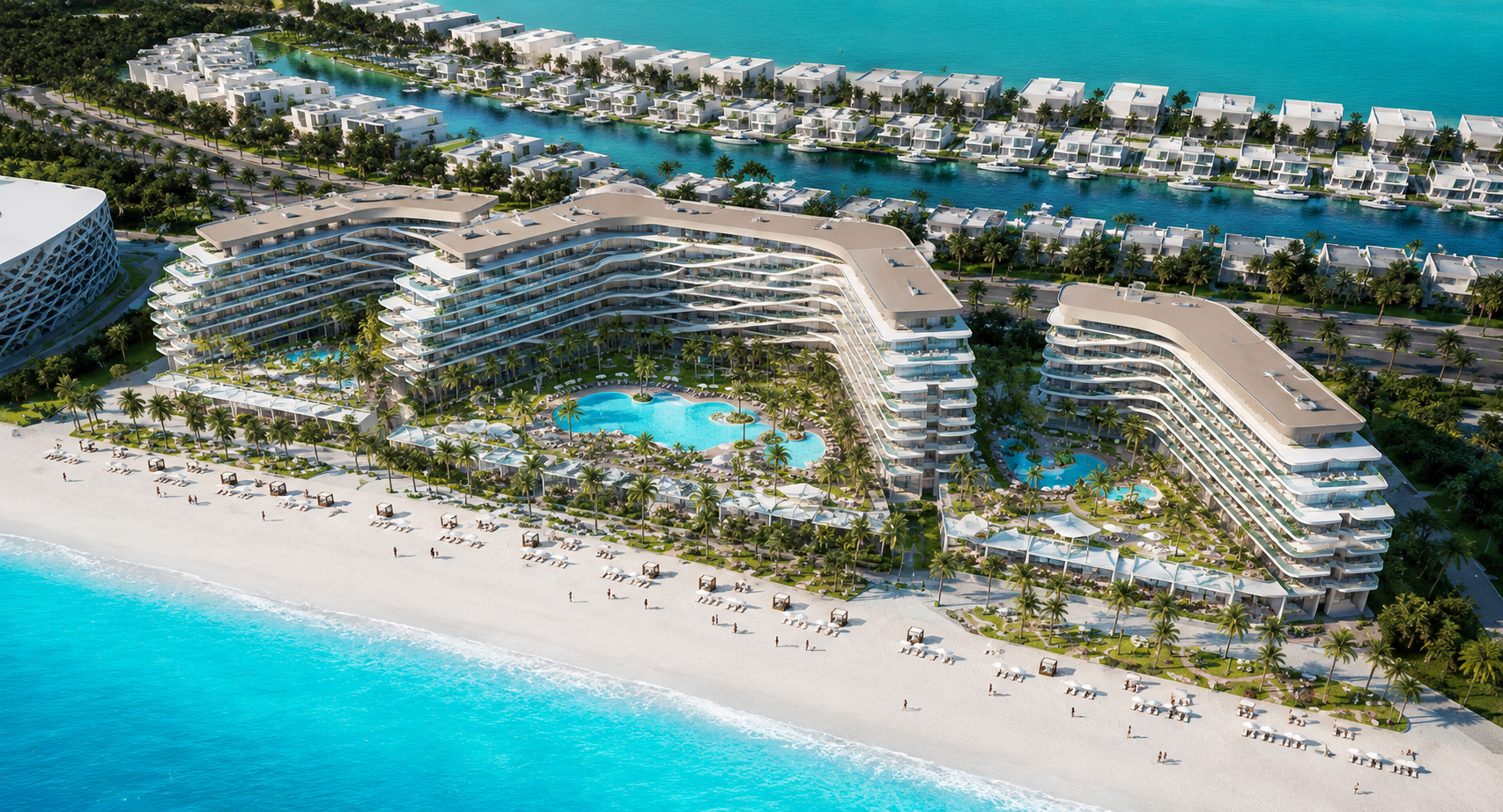
Most Dubai property investments compete on rental yield. Sobha Tranquil Beach Residences competes on scarcity.
Located within the emerging waterfront district of Dubai Islands and developed by Sobha Realty in Dubai, the project enters a market segment where long-term capital appreciation often matters more than immediate rental performance.
For investors, the central question is not whether the project can generate rental income. The real question is whether paying a premium today creates a stronger wealth-preservation and appreciation opportunity over the next decade compared with traditional Dubai residential assets.
Why Investors Are Paying More for Waterfront Scarcity
Waterfront real estate operates under a different investment framework than standard residential communities.
New apartment projects can be launched in multiple inland districts every year. Waterfront land, however, remains limited. Once prime coastal locations are developed, creating additional supply becomes increasingly difficult.
This matters because long-term pricing power is often driven by scarcity rather than construction quality alone.
Investors purchasing Sobha Tranquil Beach Residences are effectively buying access to a restricted asset class rather than simply acquiring another apartment in Dubai.
The Price Premium: Justified or Excessive?
Properties within waterfront destinations frequently command prices that are 25% to 60% higher than comparable inland projects.
At first glance, this premium can appear difficult to justify.
A buyer allocating AED 3 million to AED 4 million could often purchase larger units in communities such as Dubai Hills Estate or Jumeirah Village Circle. The difference lies in future market positioning.
When economic growth attracts international wealth into Dubai, capital tends to concentrate in limited-supply locations first. This pattern has historically benefited beachfront and waterfront assets more than mass-market developments.
The investment case therefore depends on whether future demand growth can continue supporting premium pricing levels.
Why Rental Yield Is Not the Primary Investment Driver
Investors searching for a high rental yield property UAE opportunity may find stronger alternatives elsewhere.
Realistic gross rental yields for Sobha Tranquil Beach Residences are likely to range between 5% and 6%, with net yields settling closer to 4% to 5% after expenses.
Communities such as JVC, Arjan, and Dubai South can often deliver higher cash-on-cash returns.
That does not necessarily weaken the investment case.
It simply means the source of return changes. Instead of relying primarily on rental income Dubai performance, investors depend more heavily on long-term appreciation and asset quality.
Where Future Demand Could Come From
Not all tenant demand creates equal investment outcomes.
Projects targeting price-sensitive renters often experience stronger competition during market slowdowns. Waterfront residences generally attract a different demographic profile.
Higher-income professionals, international buyers, entrepreneurs, and long-term expatriates typically prioritize location quality over minor rental price differences.
This creates greater pricing resilience during uncertain market conditions.
For investors, stronger tenant quality can sometimes be more valuable than slightly higher rental yields.
A Five-Year Capital Growth Scenario
Assume an investor acquires a residence for AED 3.8 million.
If property values appreciate by an average of 4% annually, the asset could approach AED 4.6 million within five years.
Under a stronger market scenario where Dubai Islands develops into a major waterfront destination, annual growth closer to 7% could increase value beyond AED 5.3 million.
Adding net rental returns of approximately 4% to 5% annually creates a blended return range of roughly 8% to 12%.
The calculation highlights an important reality.
Most of the projected return comes from asset appreciation rather than rental income generation.
Comparing Sobha Tranquil Beach Residences With Other Investment Options
Compared with Palm Jumeirah, Sobha Tranquil Beach Residences may offer a lower entry threshold and potentially higher growth potential if the surrounding district matures successfully.
Compared with Business Bay, investors sacrifice immediate rental depth but gain exposure to a more limited waterfront inventory.
Compared with Jumeirah Village Circle, rental yields may be lower, yet scarcity-driven appreciation could prove stronger over a longer holding period.
This creates a different risk-return profile.
Investors focused on cash flow may prefer established rental districts. Investors focused on capital preservation may view waterfront exposure more favorably.
The Overlooked Importance of Exit Liquidity
Many buyers focus exclusively on purchase price and rental income.
Institutional investors often focus on exit demand.
The future buyer pool for waterfront property tends to remain relatively international. This broadens the potential resale market compared with projects that rely almost entirely on local investors.
A wider buyer audience can support liquidity during periods when domestic demand slows.
This factor rarely appears in developer marketing materials, yet it can significantly influence total investment performance.
What Could Go Wrong?
Premium projects are not immune to risk.
Luxury real estate markets often experience larger pricing swings than mid-market communities. If global economic conditions weaken or international buyer activity slows, appreciation may take longer to materialize.
Supply growth represents another variable.
While waterfront land remains limited, competing premium developments could increase buyer choice and reduce pricing power.
Investors should also recognize that future returns are heavily dependent on the successful evolution of the broader Dubai Islands district.
Which Investor Is Most Likely to Benefit?
Sobha Tranquil Beach Residences appears best suited to investors with a medium-to-long-term holding horizon.
Buyers seeking immediate income optimization may discover better opportunities in established rental communities.
Investors focused on preserving capital, diversifying into scarce real estate assets, and participating in Dubai’s long-term waterfront expansion are more aligned with the project’s investment profile.
The project favors patience over rapid gains.
Strategic Takeaway
The strongest argument for Sobha Tranquil Beach Residences is not rental yield.
It is ownership of an asset category that remains difficult to replicate.
Many Dubai residential projects compete through pricing. Waterfront developments compete through scarcity.
That distinction becomes increasingly important as the city expands and developable coastal inventory becomes more constrained.
Final Verdict
Sobha Tranquil Beach Residences should not be viewed as a pure cash-flow investment.
Its investment thesis revolves around long-term capital appreciation, limited waterfront supply, and future demand from higher-income buyers and tenants.
The project is unlikely to rank among the highest-yielding residential investments in Dubai. It may, however, provide stronger downside protection and better long-term wealth preservation than many conventional apartment developments.
For investors seeking real estate ROI Dubai through scarcity-driven appreciation rather than maximum rental yield, Sobha Tranquil Beach Residences presents a compelling strategic allocation.
FAQs
- Is Sobha Tranquil Beach Residences primarily a rental income investment?
No, the project’s investment case is driven more by long-term appreciation potential than by maximizing annual rental returns. - What rental yield can investors realistically expect?
Most investors should model net yields between 4% and 5%, depending on purchase price and future market conditions. - How does it compare with Palm Jumeirah investments?
It offers exposure to waterfront living at a potentially lower entry point while benefiting from a developing coastal district. - Is Dubai Islands expected to support future price growth?
Future appreciation depends heavily on infrastructure delivery, district maturity, and sustained demand from local and international buyers. - Who is the ideal investor for this project?
Investors seeking capital preservation, long-term appreciation, and exposure to scarce waterfront assets are the strongest fit. - Can this project outperform inland communities over time?
It may outperform in appreciation cycles if waterfront scarcity continues supporting stronger pricing power. - What is the biggest risk associated with the investment?
The primary risk is slower-than-expected growth in luxury demand or delayed maturity of the surrounding district. - Does the project suit first-time Dubai investors?
It can, provided investors understand that appreciation rather than yield is likely to drive future returns. - How important is resale demand for this investment?
Resale demand is critical because a significant portion of projected returns depends on future asset appreciation. - Is now a reasonable entry point for investors?
Investors with a long-term horizon may benefit from entering before the surrounding waterfront ecosystem reaches full maturity.
